
Ears the Deal
By Annaliese Morgan
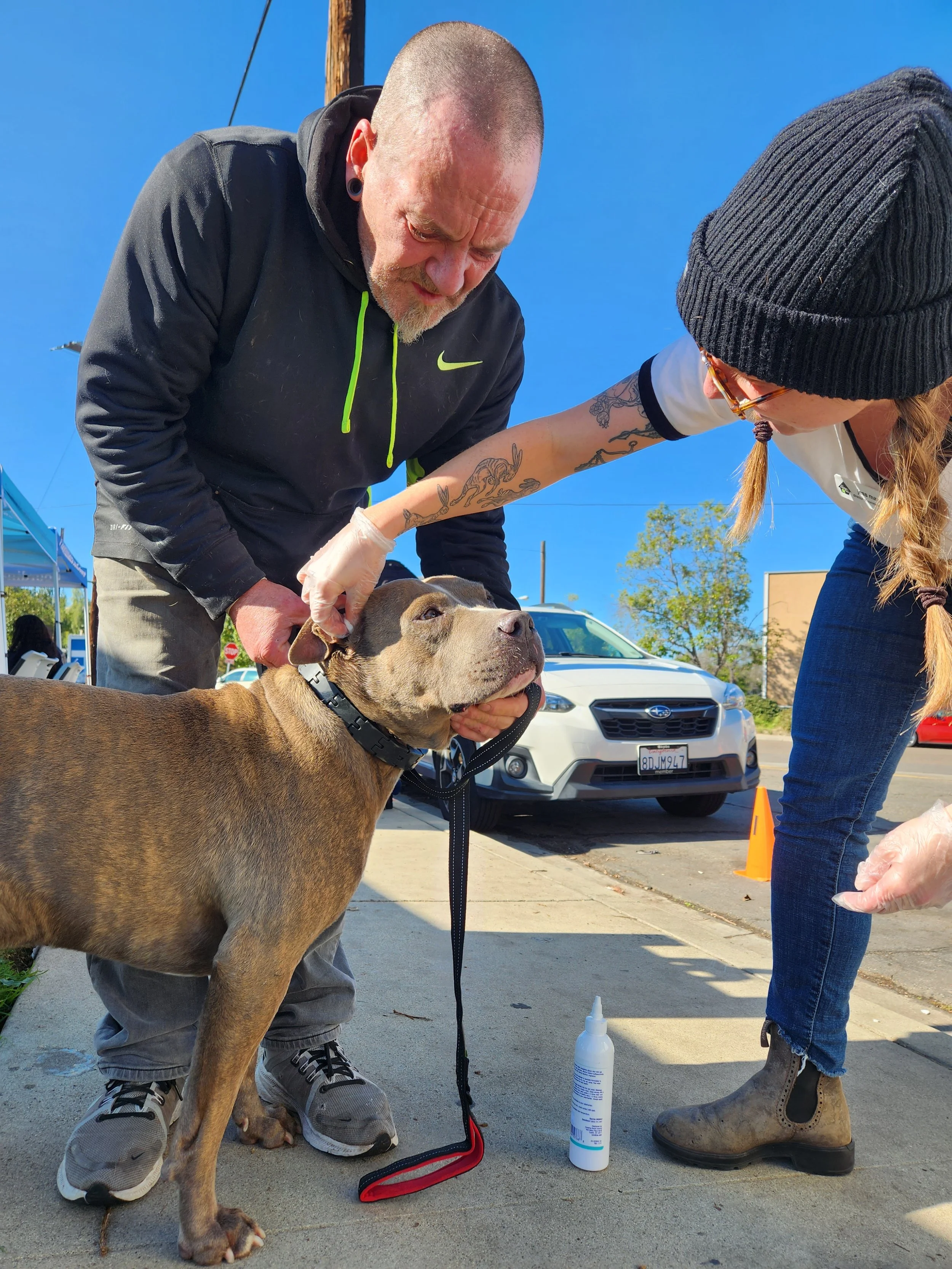
Whilst we can’t eradicate ear infections and problems, we can understand why they occur, how they affect our pets and what can be done. Raise your glass if you remember awful earache scenes from childhood with scarves wrapped around heads, magic pink medicine and hot water bottles. I’m raising mine.
You therefore likely know how painful, uncomfortable or irritating ear problems and ear health can be. Keeping them clean, debris-free and normal as best you can is the key to good ear maintenance.
Normal is a broad term. As your pet’s parent, you will know better than anyone what is normal for your pet, but for clarity, a normal textbook (outer) ear is demonstrated below.
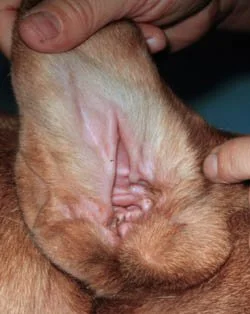
Image © Washington State University College of Veterinary Medicine
Signs of a normal, healthy ear
Salmon pink in color.
No obnoxious smells or discharges.
No bleeding.
No pink or red dots on the skin.
The visible ear canal opening should be free from hair and wax.
The ear pinna should be flat and smooth – no sores, hardness, ripples, or squashy bits.
No itching or head rubbing.
No head tilts.
No lumps.
No lack of hearing.
There are three sections to the ear:
External ear:The ear pinna, the ear canals and the eardrum (a super-thin membrane separating the external and middle ears).
Middle ear:An air-filled cavity containing three tiny bones and a tube connecting the nose and throat with the ear. It amplifies sounds and ensures ears stay at the same pressure as outside air pressure; you can feel this in action on airplanes.
Inner ear:Within the skull, containing lots of bony bits, tubes and fluid. Collectively, these detect different sounds and frequencies and are responsible for balance.
Any three of these sections can become inflamed and infected. Otitis Externa (inflammation of the outer ear) is the most common.
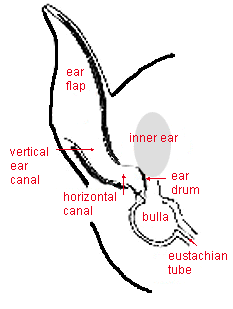
Image © Washington State University College of Veterinary Medicine
Causes of ear disease
Anatomy
Cat and dog ears differ from humans in that they have much longer vertical and horizontal ear canals joining (nearly) at a right angle halfway down.
Breed
Certain breeds, e.g. Poodles and Shih Tzus, have hairy ear canals. Hair builds up in the vertical canal until it is removed by plucking. If this is not removed, ear discomfort and infection are more likely.
Shape of the ears
The ear cartilage supporting the pinna determines its shape; some are floppy, like in Cocker Spaniels, and some are upright (to collect sounds), such as German Shepherds.
Floppy ears have decreased airflow within the ear canals, are warmer and have increased moisture. Perfect for yeasts and bacteria to grow and cause infection and disruption.
Upright ears possess better air flow and therefore less heat and moisture in the ear canals, so they have fewer problems.
Activities
Fun things, such as swimming, increase the chances of bacteria within the ear canals. Foraging in undergrowth may lead to small foreign bodies becoming lodged and stuck in the canals. Grass seeds very commonly do this. Bath or shower time often leaves water lodged in the canals.
Parasites
Ear mites (Otodectes Cynotis) are highly contagious, can pass between mother and offspring, between the same species and between dog, cat and ferret. These tiny mites live on top of the skin rather than in it and are itchy itchy itchy.
Bacterial infection
Often, these bugs are secondary to another condition. It is important to treat the cause and not just the symptoms to prevent repeated occurrences.
Fungal (yeast) infections
Fungi are more unruly pests, usually secondary to another condition. The most common is Malassezia.
Allergic skin disease
Allergies cause chaos and much perplexity. Ears are not exempt from allergies, and often your pet will exhibit sore, infected or itchy ears due to skin or seasonal allergies.
Hereditary and congenital defects
Hereditary conditions are passed on through genes. Congenital defects are conditions or defects present at birth.
Examples of hereditary ear conditions include:
The Scottish Fold cat: this breed of cat has folded ear tips.
Deafness in one or both ears: Common in Dalmatians, white Boxers, white English Bull Terriers, and white cats, particularly those with blue eyes.
Signs of ear infection or disease
Ear problems can be easily missed, especially in the early stages. With any ear issue, it is crucial the primary cause is treated and not just the symptoms, to prevent repeated occurrences.
Signs include:
Redness.
Heat.
Inflammation and/or ulceration on the inside of the ear.
Discharges from the ear, including pus and blood. Small amounts of dark brown/black wax are normal.
Obnoxious smells.
Irritation.
Scratching, using their paws to rub their ears, rubbing other parts of the head, rubbing their ears on floors or furniture.
Head shaking
Other pets may lick the infected ear of the dog or cat. FYI, this does not help it makes it worse.
Pain. This will manifest itself differently depending on your pet. Signs of pain include becoming submissive or aggressive, pawing at the ear, not eating, being generally uninterested, and lethargy.
A squishy ear pinna as though it is filled with water.
Flickering eyes (pupils moving side to side). Seen mainly in inner ear disease.
A head tilt. Seen mainly in inner ear disease.
Third eyelid protrusion and a constricted pupil on the affected side. Commonly seen in inner ear disease.
Treatment
A visit to your vet is needed. They can examine the ear and prescribe the best form of treatment. Depending on the cause and severity, you will more than likely leave with one or two of these items:
Topical ear antibiotics
Drops placed directly in the ear canal and can be used to treat infection, inflammation and mites.
Systemic antibiotics
Antibiotics are usually tablets taken orally or given by injection and may be used to treat any infection and inflammation (external, middle and inner).
Flea spot on treatments
Some of the prescription flea spot-on treatments treat and prevent ear mites.
Anti- inflammatory drugs
These are given as tablets, liquid or as an injection, providing pain relief and reduction of inflammation. Anti-inflammatory work by reducing the inflammation which by default reduces pain.
Shampoo
You may be given a special medicated shampoo to use if the ear infection is secondary to another condition.
Removal of foreign bodies
Unless immediately visible, this has to be performed under general anesthetic.
Flushing their ears
This is performed under general anesthetic. Fluid such as sterile saline is used to flush the ear out, removing all sorts of wax, debris, bugs and blockages.
Further Tests
Your vet may recommend allergy testing or extra laboratory work to identify certain bacteria, fungi or parasites.
For chronic ear conditions, there are various types of surgery available, which your vet will discuss with you
Ear Care Plan
Create an ear care plan for your specific dog or cat. Your vet or vet tech can also help. Pick and mix from the list below to suit your circumstances.
Check the ears weekly — Know what is normal and abnormal for your pet. Assigning a certain day or a certain person increases the chances of it being done.
Clean the ears once to twice monthly unless they have an infection then your vet will advise on the cleaning frequency for your individual dog — See guide below on how to clear ears.
Water-loving doggies — Clean their ears after each swimming or water episode.
Bathing — Try and avoid the ear area; alternatively, place cotton wool coated in Vaseline in the ear opening or cover it with your hand.
If you have a dog requiring hair removal from the canal (ear plucking), ensure this is done every 6–8 weeks. This is usually incorporated within standard 6–8 weekly haircuts or grooming. Good groomers will do this as routine; however, check this is done.
Use treatments regularly which prevent and treat ear mites. These are usually combined with flea treatments. Use a sticker chart or phone reminder.
If they have long hair on their ears, keep it (and their faces) knot-free, void of food and other debris. These cause pain, discomfort and irritation. Forcing an initiation of itching and shaking the head, which leads to trauma to the ear and subsequent problems.
Clean ears like a pro
Have everything ready, open and in reach. Clean the ears once or twice a week. This method may also be used for applying antibiotic drops into the ear, except you would miss out step number four.
Place your pet at a height comfortable for you, usually waist height. Tables, chairs, sofas, desks, and outside walls, for example, can all be used and thoroughly cleaned afterwards.
Have a second person steady your pet if required. A wall can be used as a backdrop to secure them, have your pet learn or sit next to the wall. Increases the feeling of being safe and limits their ability to do a runner.
Hold the ear-flap up, or hold the tip in the case of upright ears. Place the tip of the ear cleaner into the ear canal.
Apply 1 or 2 drops into the canal (be on guard, as they will likely shake their head, particularly if too much is squirted in).
Massage the base of the ear to allow the cleaner to fully circulate around the canal, picking up dirt on its way.
Using cotton wool to wipe around and in the ear. This will remove any excess cleaner, debris and wax. Do not use cotton buds/Q-tips down the ear canal, as they easily puncture the eardrum and damage nerves.
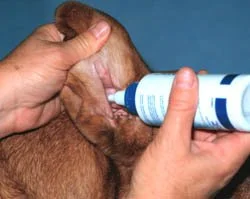
Image © Washington State University College of Veterinary Medicine
P.S.
Human ears work in the same way as pets’, except their hearing frequency is higher than ours. A human hears up to 23000Hz, whilst dogs hear up to 45000Hz and cats up to 64000Hz. If your pet is behaving like they heard something you didn’t — believe them!
Annaliese Morgan
Annaliese qualified as a veterinary nurse from Edinburgh and went on to attain a diploma in advanced veterinary nursing in surgery from London. Throughout this time, she worked in both small and mixed veterinary practices and gained head nurse status. Responsible for training other veterinary nurses she also ran the nursing department, nurse clinics, and patient care protocols.
She has looked after 1,000s of patients and owners and created new higher standard nursing regimes, whilst specializing in surgery and anesthesia. After being asked to co-author multiple veterinary nursing textbooks, Annaliese continued to write for further mainstream publications in the UK and USA and after twenty-plus years in both the veterinary and pet care professions, she hung up her scrub suit and now writes full-time.